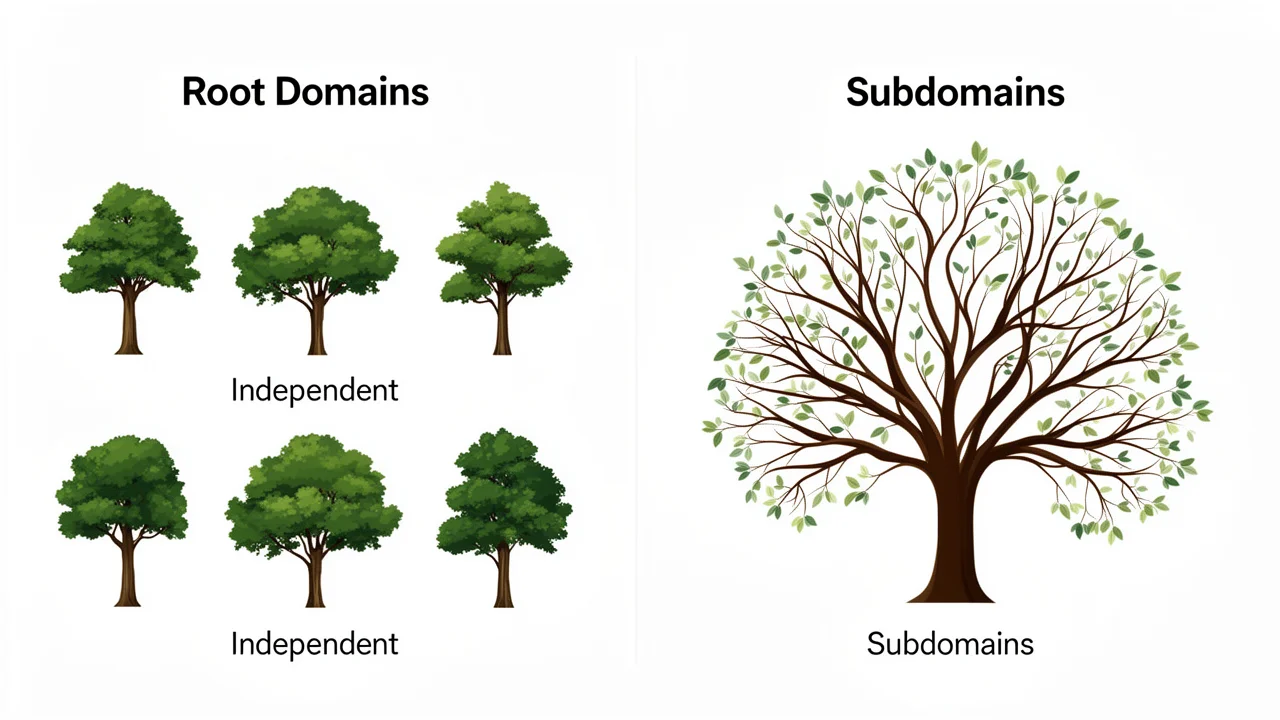
Understanding the Technical Difference
At its core, this debate is about website architecture and how search engines perceive different structures.
- Root Domain (Separate Site): This is a fully independent website with its own domain name (e.g.,
gardeningtips.com). It accrues its own backlink profile, domain authority, and search engine trust independently. - Subdomain: A section of a root domain, treated somewhat separately by search engines (e.g.,blog.gardeningtips.com). While it can develop its own profile, it is inherently tied to the root domain (gardeningtips.com). - Subdirectory: A folder within a root domain (e.g.,gardeningtips.com/blog/). This is fully part of the root domain, and all authority is shared directly.
For PBNs, the primary comparison is between using multiple root domains versus multiple subdomains of one or a few root domains. Subdirectories are rarely used for PBNs as they offer no separation.
SEO Impact: Authority and Link Equity
The SEO impact centers on ’link equity’ or ‘PageRank’ flow.
Root Domain (Separate Site) Approach: - Pro: Each site is an independent entity. A penalty on one PBN site is less likely to directly affect the others or the money site, as connections are harder to prove. - Pro: Each site builds its own unique authority from its backlinks, which is then passed via your placed links. This is seen as more powerful. - Con: Requires managing many separate hosting accounts, domains, and software installations—a significant logistical challenge addressed by PBN management solutions.
Subdomain Approach: - Pro: Much easier to manage. You host everything on one primary hosting account and manage it through a single WordPress install with tools designed for subdomain management. - Con: All subdomains share the fate of the root domain. If Google penalizes the root domain (maindomain.com), all subdomains (blog.maindomain.com, news.maindomain.com) are likely affected, and any money sites linked from them are at higher risk. - Con: Search engines may not pass as much independent link equity from a subdomain as they would from a separate root domain.
Risk Analysis and Footprint Considerations
Risk management is paramount in PBN strategy.
Root Domain Network Risk Profile: - Lower Interconnectivity Risk: With diversified hosting, IPs, and registrars, proving a connection between sites is harder for algorithms. - Higher Cost of Failure: Losing one aged, authoritative domain is a significant financial and strategic loss. - More Footprints to Hide: Requires meticulous work to vary themes, plugins, and content across many independent installations.
Subdomain Network Risk Profile: - Higher Centralized Risk: The single root domain is a major point of failure. Its discovery links ALL your PBN sites and potentially your money sites in one obvious footprint. - Easier to Maintain Anonymity: Technically, you only need to hide the footprint of one root domain’s ownership, not dozens. - Potential for Scalability: Platforms like Turbo Subdomains demonstrate that creating many unique subdomains from one install is technically feasible, but the strategic risk remains concentrated. This makes seamless Cloudflare integration critical for performance and masking origin servers.
Management and Operational Overhead
The choice heavily influences day-to-day operations.
Managing 50 Root Domains: - Hosting: 50+ separate hosting accounts or VPS instances. - Updates: 50 separate WordPress installs to update for core, themes, and plugins. - Content: 50 separate sites needing unique content. - Tracking: 50 different analytics and Search Console profiles.
Managing 50 Subdomains: - Hosting: Potentially just 1-2 hosting accounts. - Updates: Often a single WordPress install (using multi-site or specialized software). - Content: 50 unique sites, but publishing is centralized. - Tracking: Can be centralized or separated.
The subdomain model offers immense operational efficiency, which is why it’s attractive for large-scale content network operations. However, this efficiency must be weighed against the consolidated risk.
Which Strategy Should You Choose?
There is no one-size-fits-all answer; it depends on your risk tolerance, budget, and technical skill.
Choose Separate Root Domains If: - Your primary concern is maximum safety and minimizing the risk of a network-wide penalty. - You are building a small, high-quality network (e.g., 5-20 sites) with a significant budget for domains and hosting. - You are targeting extremely competitive, high-value keywords where independent authority is crucial.
Consider a Subdomain Strategy If: - You are building a larger network (50+ sites) where management overhead for root domains is prohibitive. - You are using the network for lower-risk, tiered link-building (e.g., PBN links to buffer sites, which then link to your money site). - You have access to a very strong, aged, and clean root domain that you are confident can support the subdomain structure. - You employ advanced masking and website management techniques to mitigate the centralized risk. For many, a hybrid approach—using root domains for high-power tiers and subdomains for larger, supporting tiers—offers a balanced path.